
Let’s wind the clock back for a second. If you were online in the early 2000s, you might remember how searching on Google felt like playing a guessing game. Seriously, it was a mess. You’d type in “how to fix a flat tire,” and half the results would be these Frankenstein articles stitched together with the same phrase repeated in every other sentence. The actual advice? Sometimes missing entirely.
But if “fix a flat tire” showed up enough times, that site hit page one, no questions asked. Honestly, it was almost comical.I have vivid memories of landing on pages clearly written just to “game the system.” They’d say things like, “To fix a flat tire, you must know how to fix a flat tire. Once you know how to fix a flat tire, fixing a flat tire is simple!” I mean…really?
Today, businesses looking to build long-term visibility are moving towards Best Semantic SEO Services that focus on search intent, topical authority, and creating genuinely useful content rather than simply repeating keywords. “Got 3%? Perfect.” Never mind that the article sounded like it was written by a robot with a head injury. The fact that you, as a reader, walked away more confused than when you arrived? Didn’t matter
But here’s the wild part: that nonsense worked For a while, at least.
The Keyword Era: When Math Trumped Meaning
Back then, SEO was largely a numbers game. You could almost picture some marketer with a calculator, checking keyword density and celebrating once it hit the “perfect” percentage. Unfortunately, many of those articles felt unnatural and repetitive because they were written for search engines instead of real people.
Back then, Google and let’s be honest, most search engines were dumb. They simply matched text strings. If you could stuff enough “magic words” into your article, you won. It was almost like cheating at an open-book test: you knew the formula, so you aced it, even if you didn’t really know the subject.
I sometimes joke that you could have gotten a dog to outrank a PhD professor, so long as the dog could type “best dog food” enough times!
Why Did It All Change?
The internet started growing up. People wanted real answers, not just spammy pages. Google noticed. Suddenly, they weren’t just interested in what words you used, but how you used them. Could you actually help someone? Did you cover the topic in a way that made sense? Were you, you know, an actual expert?
If you’re like me, you probably remember when Google started rolling out big, scary-sounding updates Panda, Penguin, Hummingbird. For most folks, these were just headlines in SEO blogs. But under the hood, they changed everything.
Hummingbird (2013) was a game changer. For the first time, Google started trying to understand searches, rather than just match words. Instead of treating each word as an island, Google tried to connect them—like a detective piecing together clues.
And wow, did it work. Suddenly, low-quality keyword-stuffed pages started vanishing from the top spots. The days of “just repeat your keyword and pray” were over.
Enter Semantic SEO: Context Is King
So what’s really changed with Semantic SEO? In a word: context.
Imagine you search for “apple.” What are you looking for? Is it the fruit, the tech company, or maybe even the Beatles’ record label? Old-school SEO couldn’t tell. But today, Google looks at the context around your words. Are you mentioning “orchards,” “vitamins,” or “fiber”? Probably the fruit. But if there’s talk about “iPhones,” “MacBook,” and “Cupertino,” you’re probably after the tech giant.
That’s the magic of semantic search. It connects the dots. It doesn’t just see the word “apple” it tries to figure out what you actually mean.
Why Semantic SEO Matters for Your Website ?
Let’s be honest: most people don’t care about the technical details of search engines. They care about results. If you’re building a business, a blog, or really anything online, you want people to find you for the right reasons. It’s not just about getting clicks, it’s about getting the right clicks.
Semantic SEO means you don’t have to play the keyword-stuffing game anymore. You can focus on actually helping your audience. If you cover your topic thoroughly, answer real questions, and connect related ideas, you’ll naturally start ranking for dozens (sometimes hundreds) of related searches even ones you never expected.
Let me give you a quick example from my own life. A couple years ago, I rewrote an old post about “home office setups.” Instead of just repeating “home office” everywhere, I talked about remote work challenges, lighting tips, distractions, ergonomic chairs, and even how to keep your cat off your keyboard (real struggle). Within months, the article started ranking not just for “home office setup,” but “best desk for small space,” “how to work from home with pets,” “cheap ways to soundproof a room,” and so on. That’s the power of semantic search.
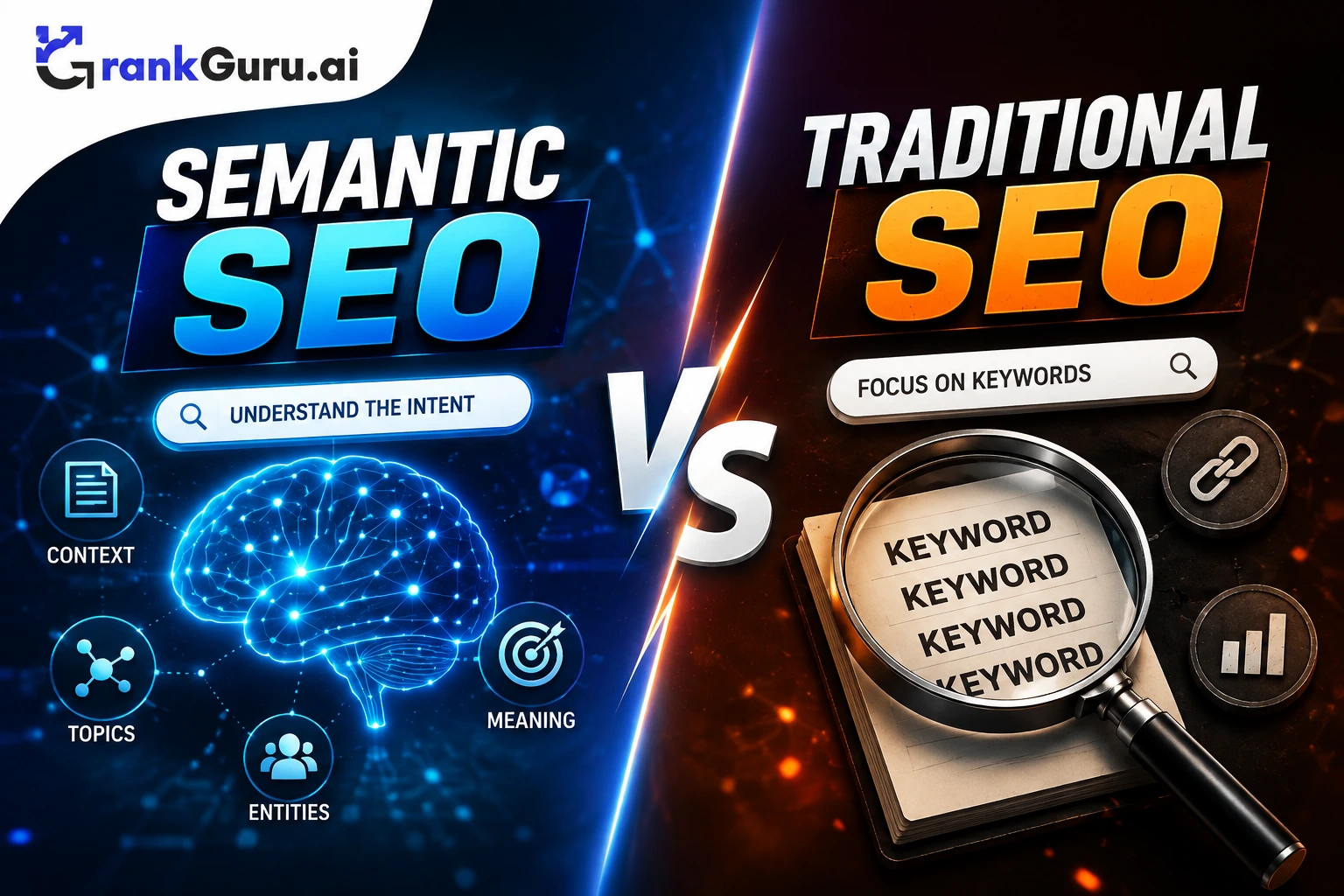
What’s Really Different: Traditional vs. Semantic SEO
Let’s break this down in plain English. Here’s how I explain it to clients:
| Old SEO | Semantic SEO | |
| Main Focus | Exact keyword matching | Topic depth, context, and intent |
| Content Structure | Standalone, isolated pages | Interconnected topic clusters |
| Writing Style | Awkward, repetitive, stiff | Natural, helpful, conversational |
| Ranking Factors | Keywords, backlinks | Entities, relationships, E-E-A-T |
| User Experience | Written for bots | Written for humans |
Old SEO is like trying to win a spelling bee by shouting the same word over and over. Semantic SEO is more like having a real conversation, listening, responding, and showing you get the big picture.
Entities, Knowledge Graphs, and All That Jazz
Let’s talk about entities for a second. Don’t let the word scare you. It just means “things” Google knows about people, places, brands, concepts, events, and so on. Google stores all these in its “Knowledge Graph,” which is basically a gigantic spiderweb of connections.
When you write about “jazz music,” Google expects to see names like “Louis Armstrong,” “Duke Ellington,” “bebop,” “improvisation,” “New Orleans.” If you mention these naturally, your content looks deep and authoritative.
It’s a little like showing your work in math class. If you hit all the related ideas, Google’s like, “Yep, this person knows what they’re talking about.”
The Death of Keyword Density
Remember when everyone obsessed over keyword density? “Should I use my target phrase 2%, 3%, or 4% of the time?” These days, that’s ancient history. If you’re still sweating over keyword percentages, you’re missing the point.
Here’s the truth: Google can spot keyword stuffing a mile away. If your content only ranks because you repeated “best running shoes” twenty times, it’s on borrowed time. The next algorithm update will send it packing.
Instead, focus on real topical coverage. Answer questions. Give examples. Use synonyms and related phrases. Go deep, not just wide.
Why Intent Is Everything
Here’s a secret: every search has intent. That’s just a fancy way of saying, “What does the searcher actually want?”
Let’s break down the four types:
- Informational: “What is SEO?” (Just wants to learn)
- Navigational: “Quillbot homepage” (Wants a specific site or page)
- Commercial: “Best laptop for writers” (Comparing options)
- Transactional: “Buy standing desk online” (Ready to make a purchase)
Semantic SEO lets you match your content to the right intent. If someone’s looking to buy, don’t bury them in definitions. If they want to learn, give them the full story. The best sites now build content for all four intents, connecting them with smart internal links so people can move from “just browsing” to “ready to buy” seamlessly.
How Do You Actually Do Semantic SEO? (A Real-World Guide)
Let’s get practical. Here’s how I approach semantic SEO for myself and my clients:
1. Build Topic Clusters
Stop thinking in terms of random blog posts. Instead, map out your main topics (pillar pages) and the supporting articles (cluster pages) that answer every possible sub-question.
Example:
Pillar Page: “The Ultimate Guide to Dog Training”
Cluster Pages: “How to Stop Barking,” “Best Treats for Training,” “Clicker Training Basics,” “How to Train Older Dogs”
Link these pages together naturally. This not only helps search engines, but also keeps readers clicking around your site.
2. Use Entities and Natural Language
Talk like a real person. Use natural phrases, not just your target keyword. Include related ideas and entities. If you’re writing about coffee, mention beans, brewing methods, grinders, acidity, and even that weird French press you bought and never use.
3. Add Schema Markup
A little technical, but worth it. Schema helps Google understand what your page is about at a glance. Want to show up in rich results, FAQs, reviews, or how-to snippets? Schema is your friend. There are plugins that make this easier, so you don’t need to be a coder.
4. Answer Questions (Directly!)
People use voice search more than ever. That means they’re typing or speaking in full sentences: “How do I change a bike tire without tools?” Don’t make them dig. Add FAQs, summary boxes, and step-by-step guides right in your content.
5. Update and Expand Content Regularly
Don’t treat content like a one-and-done project. Google loves freshness. Review your articles every few months, add new info, and keep those topic clusters up to date. Even small updates can make a big difference.
6. Look at the SERPs Constantly
Don’t guess what Google wants—check for yourself! Look at the “People Also Ask” boxes, related searches, and top-ranking pages. Google’s basically handing you a list of what it thinks matters.
My Story: The Power of Going Deep
I’ll admit, when I first heard about Semantic SEO, I was skeptical. Was this just another buzzword? Did I really need to change how I’d been doing SEO for years?
But after one too many algorithm updates tanked some of my old, keyword-stuffed articles, I decided to try something new. I took a topic I thought I knew well—how to start a podcast and built out a full cluster.
I wrote a long, detailed pillar page, then spun off guides on microphones, editing software, hosting platforms, monetization, and even marketing. I answered every question I’d seen in forums and Facebook groups. I shared stories about my own podcasting struggles (like the time I spent an hour recording with my mic turned off).
The result? Not only did my main article climb the rankings, but so did all the supporting posts. Traffic tripled. People started reaching out with real questions—and eventually, business opportunities followed. That’s the magic of going deep, not wide.
As businesses continue adapting to a more connected digital environment, initiatives like the Government of India’s Digital India Programme highlight the growing importance of accessible, reliable, and meaningful online information.
Why Semantic SEO Is a Game-Changer
Let’s wrap this up with a few reasons why Semantic SEO matters not just for rankings, but for your whole online presence:
Higher Quality Traffic: You’ll attract visitors who actually want what you offer, not just people who clicked by accident.
More Conversions: When you answer real questions and build trust, people stick around and are more likely to buy, subscribe, or share your stuff.
Algorithm-Proofing: When Google updates roll out (and they always do), sites built on depth and authority tend to survive and even grow.
Better User Experience: Your content will actually help people. That means more engagement, longer visits, and more shares.
The Bottom Line
If you’re still treating SEO like a guessing game or a math problem, you’re missing out. The future of search is about meaning, context, and expertise. Semantic SEO isn’t just a trend, it’s the new way to win.
So here’s my challenge to you: pick a topic you want to own, go deep, answer real questions, and connect all the dots. Write for humans, not just for bots. If you do, you’ll not only see better rankings you’ll build a site people trust, share, and come back to.
And if you want help mapping out your own semantic strategy, don’t be afraid to reach out. There’s never been a better time to make your content truly helpful.
Pro tip: If you want to see what Google values, their Search Ranking Systems page is worth a look. It’s a bit dry, but it’s the real deal.
FAQs:
Q: Does keyword density matter at all anymore?
A: Nope. Use your main phrase a couple of times, but don’t obsess. Focus on covering the topic and using natural language.
Q: How do topic clusters help?
A: They organize your site, signal expertise to Google, and keep readers exploring more of your content.
Q: Is Schema markup worth my time?
A: Absolutely. It can get your site into rich results and helps Google “read” your pages more easily.