
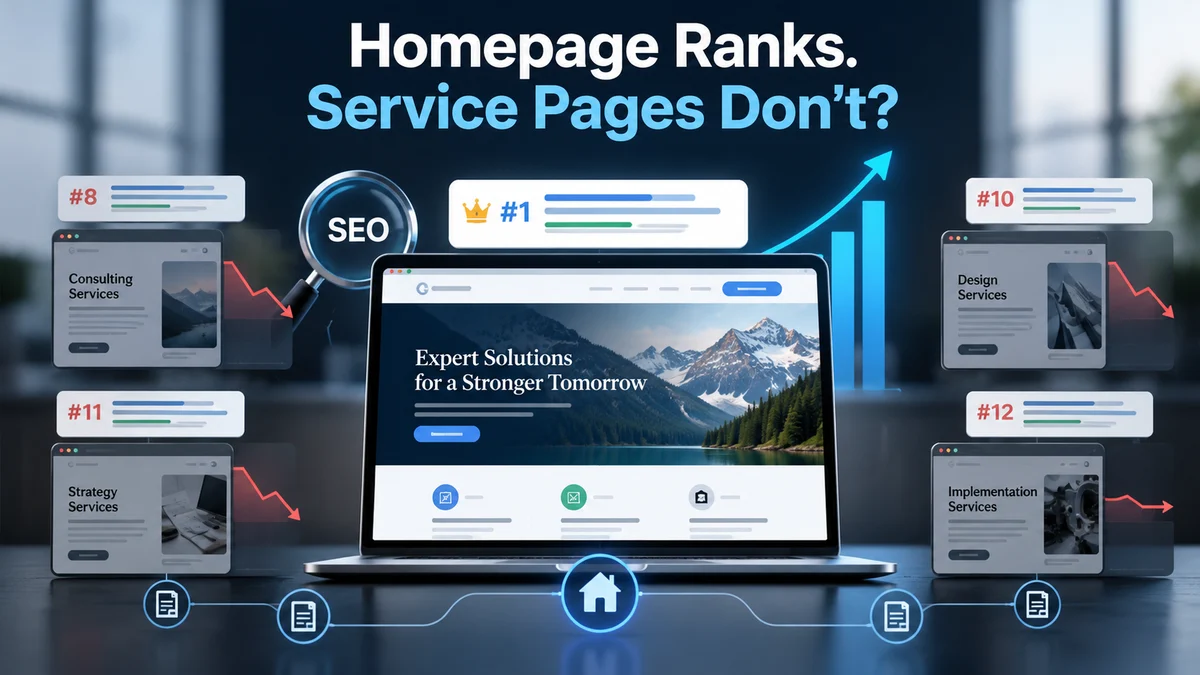
Your homepage looks great in Google. It appears when people search for your business, attracts visitors, and seems to have a healthy relationship with search engines. But there’s a problem. Your actual service pages? Practically invisible. You offer web design, consulting, accounting, or another professional service, yet potential customers struggle to find those individual pages.
This situation happens to businesses worldwide, from boutique agencies in New York to consulting firms in London and growing startups in Singapore. Your homepage gets the spotlight while the pages that should generate enquiries sit quietly in the background. It’s like opening a beautiful shopping mall where nobody can find the individual stores.
I often look at this problem as a disconnect between website authority, search intent, and page-level SEO. A strong homepage doesn’t automatically make every service page competitive. That’s where Ai SEO Solutions can help identify content weaknesses, technical problems, and missed optimisation opportunities that prevent important pages from reaching potential customers.
Why Does Your Homepage Rank Better Than Your Service Pages?
First, understand what your homepage rankings actually represent. Your homepage often attracts branded searches, backlinks, direct mentions, and internal links. Search engines may therefore recognise it as the main destination for people looking for your company.
However, ranking for your business name doesn’t mean your website can compete for searches like “professional website design services” or “business tax consulting.” These searches involve different expectations, competitors, and levels of buying intent.
1. Your Internal Linking Structure Favours the Homepage
Imagine your website as a city. Your homepage serves as the central station, while individual service pages represent different neighbourhoods. If every road leads back to the station but very few lead to those neighbourhoods, visitors and search engines have a harder time exploring them.
Google explains in its link best practices guide that crawlable links and descriptive anchor text help its systems discover pages and understand their content. This makes internal linking an important part of service page SEO, especially when your homepage receives most of your site’s attention.
How to fix it:
- Link relevant service pages from your homepage content.
- Include your main services in clear navigation menus.
- Connect related blog posts with contextual internal links.
- Use descriptive anchors such as “website maintenance services” instead of generic phrases like “click here.”
- Make sure every important service page has at least one crawlable internal link.
Practical tip: Don’t simply add 20 service links to your footer and call it an SEO strategy. Place links where readers naturally need more information.
2. Your Service Pages Don’t Match Search Intent
Here’s a common mistake: businesses create service pages around what they want to say rather than what customers want to find.
Suppose you offer digital marketing services.
Your page headline says:
“Transforming Businesses Through Innovative Digital Experiences.”
Sounds impressive. But someone searching for “SEO services for small businesses” may struggle to understand whether the page offers what they need.
Search engines aim to match results with the user’s intent. If competitors answer that intent more directly, your beautiful headline won’t solve the relevance problem.
How to fix it:
- Identify one primary search intent for each service page.
- Use relevant service keywords naturally in the title, H1, and supporting headings.
- Explain your offering within the opening section.
- Answer common customer questions before visitors need to ask.
- Review the current search results to understand which page types Google favours.
Remember, clever messaging can attract attention, but clarity helps visitors make decisions.
3. Your Service Page Content Is Too Thin
A homepage might contain detailed information about your company, services, achievements, and customer experience.
Meanwhile, individual service pages sometimes offer little more than a headline, two paragraphs, and a contact button.
That’s not much for a search engine or a potential customer to work with.
Google doesn’t require a particular word count. Still, a page needs enough useful information to satisfy the searcher’s needs.
A strong service page should explain:
- What you offer: Define the service in clear language.
- Who needs it: Describe your ideal customer.
- How it works: Explain your process and deliverables.
- Why you’re qualified: Show relevant experience and expertise.
- What makes you different: Share meaningful advantages.
- What happens next: Provide a clear enquiry or booking option.
For example, a cybersecurity consulting page should do more than promise “enterprise-grade protection.” It should explain the assessments, reports, security improvements, and support customers can expect.
Specific information builds confidence. Empty marketing language just takes up space.
4. Your Homepage and Service Pages Compete for the Same Keywords
Sometimes the problem isn’t a lack of optimisation. It’s overlapping optimisation.
You might target “digital marketing agency” on your homepage and repeat that exact focus across several service pages.
Now multiple URLs compete for similar searches without providing clearly different answers.
This issue often falls under keyword cannibalisation, although multiple pages appearing for the same query isn’t automatically harmful.
The real concern arises when your pages serve overlapping purposes and neither delivers a sufficiently distinct experience.
How to fix it:
Create a keyword map that assigns a clear topic and search intent to every important page.
| Page | Main keyword target | Search intent |
| Homepage | Digital marketing agency | Agency discovery |
| SEO service page | SEO services for businesses | Service enquiry |
| PPC service page | PPC management services | Service comparison |
| Content service page | Content marketing services | Service enquiry |
| Blog article | SEO vs PPC | Informational research |
Check Google Search Console to see which URLs receive impressions for each target query.
If your homepage consistently appears for a service-specific query while the intended page struggles, investigate whether the content and internal links clearly distinguish their roles.
5. Your Service Pages Have Indexing or Technical SEO Issues
Sometimes your content looks perfect, but Google can’t properly access or index the page.
Common technical problems include:
- Accidental noindex directives.
- Canonical tags that point to another URL.
- Broken internal links or unexpected redirects.
- Server errors that prevent reliable crawling.
- JavaScript implementations that make essential content or links difficult to discover.
- Important URLs missing from your XML sitemap.
An indexed page can still rank poorly, so don’t treat indexation as proof of SEO quality.
Start with Google Search Console.
Open URL Inspection, enter an underperforming service page, and review its indexing status.
Pay particular attention to the Google-selected canonical URL. If Google chooses your homepage or another service page as canonical, investigate duplicated content and conflicting technical signals.
Fix the underlying issue before requesting another crawl.
6. Your Service Pages Lack Strong Trust Signals
Picture two agencies offering identical consulting services.
The first website says, “We deliver outstanding results.”
The second explains its approach, introduces experienced specialists, presents a relevant case study, and shows actual project outcomes.
Which would you trust?
Your visitors probably have the same instinct.
Google’s people-first content guidance also encourages clear authorship, demonstrable expertise, original insights, and reliable information.
To strengthen service page credibility, include:
- Relevant client testimonials with appropriate permission.
- Real case studies and measurable outcomes.
- Team qualifications and professional experience.
- Transparent service processes.
- Clear business contact information.
- Genuine examples of completed work.
Avoid invented testimonials or unsupported claims like “guaranteed number one rankings.”
A trustworthy service page should make customers feel confident about contacting you, not suspicious about your promises.
7. Your Homepage Has More External Authority
Your homepage often earns backlinks naturally through business listings, partnerships, publications, and other websites mentioning your company.
Individual service pages may attract far fewer relevant references.
Backlinks aren’t the only ranking factor, but relevant links can help search engines discover pages and assess their significance.
Instead of chasing random backlinks, look for genuine opportunities to demonstrate expertise.
You could publish original research, contribute useful industry insights, build a helpful resource, or earn references from relevant professional organisations.
Then connect those resources to the appropriate service pages through internal links.
The goal isn’t to manufacture authority. It’s to make your expertise easier to discover.
8. Your Service Pages Ignore Geographic Search Intent
This issue becomes especially important for companies serving specific cities or countries.
For example, a plumbing company operating in multiple cities might have a strong homepage but weak local service pages.
Why?
Perhaps every location page repeats identical content and simply changes the city name.
Customers want relevant details about the services available in their area. Generic location swapping rarely delivers much value.
Where location pages serve genuine customer needs, include:
- Actual service coverage information.
- Relevant local examples or completed projects.
- Location-specific customer questions.
- Accurate contact and business details.
- Genuine differences in service availability.
For global businesses, consider country-specific terminology, language, currency, and customer expectations where relevant.
Don’t create hundreds of nearly identical pages simply to target every possible location.
How to Find Out Why Your Service Pages Aren’t Ranking
Before rewriting your entire website, investigate the evidence.
A simple SEO diagnostic table can help you identify where to focus first.
| What you notice | Possible reason | First action |
| Homepage gets mostly branded clicks | Strong brand demand | Compare branded and non-branded queries |
| Service page gets almost no impressions | Indexing, relevance, or competition | Inspect URL and target queries |
| Service page gets impressions but few clicks | Weak title or poor query alignment | Review search snippets and intent |
| Homepage appears for a service keyword | Overlapping keyword targeting | Compare both pages and their links |
| Several service pages look identical | Limited unique value | Strengthen page-specific content |
| Page ranks but generates no enquiries | Conversion or offer issue | Review CTA, trust signals, and user journey |
Don’t jump to conclusions from rankings alone. Review impressions, clicks, queries, indexing, and conversions together.
A Practical SEO Action Plan for Better Service Page Rankings
You don’t need to rebuild your entire site immediately. Start with the pages that offer the greatest business value.
Step 1: Identify your priority services. Choose three to five service pages that could generate meaningful enquiries. Focus on customer demand and commercial importance.
Step 2: Review search performance. In Google Search Console, select each service URL and inspect its queries, impressions, clicks, and average position. Compare recent performance with a previous period.
Step 3: Improve content relevance. Rewrite vague headings, clarify the offering, strengthen useful information, and address the questions customers ask before purchasing.
Step 4: Strengthen internal links and technical foundations. Connect relevant articles and navigation elements to each service page. Check indexing, canonicals, redirects, and mobile usability.
Step 5: Measure progress. Track non-branded impressions, qualified clicks, enquiries, and conversions. Revisit the results after Google has had an opportunity to process your changes.
SEO improvements don’t follow a fixed timetable, and no optimisation guarantees rankings. Consistent measurement helps you distinguish genuine progress from ordinary search fluctuations.
Conclusion: Your Homepage Should Open Doors, Not Steal the Show
When your homepage ranks but service pages don’t, the issue usually involves more than a missing keyword.
Weak internal links, unclear search intent, limited content, technical problems, and insufficient credibility can all prevent individual pages from competing effectively.
Your homepage should introduce your business. Your service pages should explain what you deliver, answer customer questions, and give people a convincing reason to get in touch.
Ready to improve your service page visibility? Start with a focused SEO audit, prioritise your most valuable services, and build a clear optimisation plan. If you need expert support, contact us to discuss how better SEO can turn overlooked service pages into stronger sources of qualified traffic and enquiries.
Frequently Asked Questions
1. Why does my homepage rank on Google but my service pages don’t?
Your homepage may attract stronger brand searches, backlinks, and internal links than individual service pages. Service pages can also struggle because of weak content, unclear keyword targeting, technical issues, or stronger competitors.
2. How many words should a service page have for SEO?
Google doesn’t recommend a fixed word count. Include enough information to explain your service, address customer concerns, demonstrate expertise, and help visitors decide what to do next. Useful content matters more than length.
3. Can internal linking improve service page rankings?
Yes, relevant internal links help search engines discover pages and understand their relationship to other website content. They also guide visitors toward appropriate services. However, internal links alone cannot guarantee better rankings.
4. Should every service have its own SEO landing page?
Create separate pages when services address genuinely different customer needs or search intents. Avoid creating multiple nearly identical pages that offer little unique value. Each page should have a clear purpose.
5. How long does it take for service pages to rank after SEO improvements?
Results vary according to competition, website history, content quality, technical conditions, and Google’s crawling and ranking processes. Some changes may become visible within weeks, while competitive keywords can take several months or longer.
6. Should I target the same keywords on my homepage and service pages?
Some keyword overlap is natural. However, your homepage should usually focus on broader business discovery, while individual service pages target specific offerings and customer needs. Use distinct content and intent to avoid unnecessary competition between URLs.