
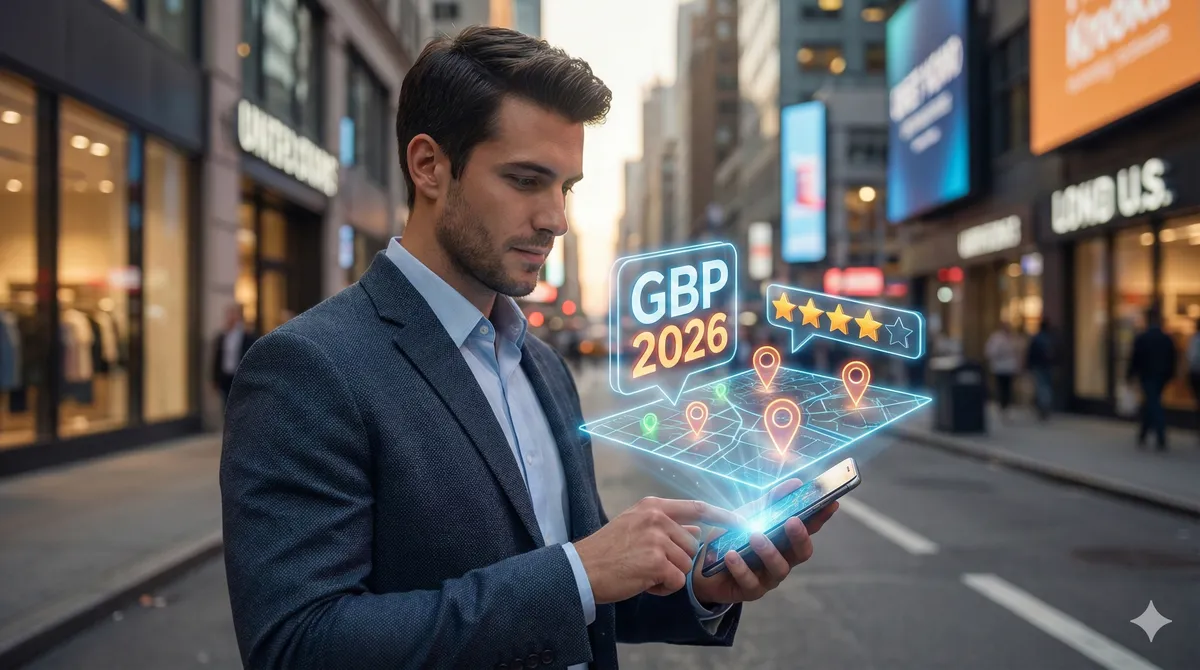
The digital landscape of 2026 isn’t just different; it’s unrecognizable from the “keyword stuffing” days of yore. If you’re a business owner in the U.S. today, you know the drill: your customer isn’t just looking for a coffee shop; they’re looking for the pour-over spot with oat milk, 4.8 stars, and a vibe that screams “remote work haven,” all while standing on a street corner in Brooklyn or Austin.
Local SEO has evolved from a simple checklist into a dynamic, AI-driven conversation between your brand and the algorithm.
The stakes? Higher than ever. With the rise of “zero-click” searches—where Google’s AI Overviews give the answer without the user ever visiting a website—your Google Business Profile (GBP) has effectively become your new homepage.
It is the first, and often the only, impression you make. Capturing those leads means understanding that “near me” is no longer just about proximity; it’s about immediacy and trust.
Navigating this requires more than just filling out a form. It demands a strategic approach to digital presence that blends technical precision with genuine community engagement.
Whether you are running a boutique law firm or a vintage clothing store, the path to visibility involves leveraging specific local seo solutions that align with these new algorithmic appetites. It is about proving to Google that you aren’t just located in the area, but that you are an integral part of it.
The New Pillars of Local Ranking: It’s Not Just “Near Me” Anymore
Remember when “Relevance, Distance, and Prominence” were the holy trinity? They still are, but 2026 has added a fourth, silent partner: Contextual Trust.
Google’s AI doesn’t just scan for keywords; it “reads” images and “listens” to the sentiment in your reviews. It wants to know if your “open now” status is reliable or if your menu photos match the current season.
- Relevance: It’s no longer enough to be an “Italian Restaurant.” You need to be at the “Family-friendly pasta spot with gluten-free options.” Specificity wins.
- Distance: You can’t move your building, but you can expand your digital footprint by creating location-specific service pages that signal hyper-local relevance to the algorithm.
- Prominence: This is where the magic happens. Mentions in local news, heavy engagement on your GBP posts, and a steady stream of reviews signal to Google that you are a local celebrity in your niche.
Visuals Are the New Keywords
If you are treating your GBP photos like an afterthought, you are leaving money on the table. In 2026, visual search will be dominant. Users—especially the Gen Z and Millennial demographics—are searching with their eyes. They want to see the vibe, the plating, the team, and the interior before they even consider clicking “Directions.”
A profile with high-quality, regularly updated photos doesn’t just look good; it signals activity. Google’s vision AI analyzes these images to understand what you sell. A photo of a latte art heart tags you for “coffee,” “latte,” and “cafe” without you typing a single word.
Impact of Visuals on Consumer Action (2026 Data)
| User Action | Metric Impact with Optimized Photos |
| Direction Requests | +42% Increase |
| Website Clicks | +35% Increase |
| Time Spent on Profile | +50% Increase |
| Trust Score | 2.7x Higher Perception of Credibility |
Data compiled from recent 2026 Local SEO behavior studies.
The “Zero-Click” Reality check
Here is a hard truth: nearly 60% of mobile searches now end without a click to a website. Why? Because Google gave them the answer right there on the results page. Your phone number, hours, address, and answers to “do they have Wi-Fi?” are all visible instantly.
This doesn’t mean your website is dead; it means your GBP needs to do the heavy lifting of a landing page. You need to treat your GBP features—like Google Posts, Q&A, and Services—as mini-webpages. When a user sees your profile, they should be able to convert (book, call, buy) without needing to dig any deeper.
To truly capitalize on this, you must look at off-page signals as well. Building citations on reputable local directories and earning backlinks from community organizations helps solidify your authority. For a deeper dive into technical structuring for these signals, resources like Google’s own guide on local ranking remain the gold standard for understanding the baseline requirements.
Reviews: The Currency of 2026
Reviews are no longer just social proof; they are SEO gold. In 2026, the content of the review matters as much as the star rating. A 5-star review with no text is nice. A 5-star review that says, “Best emergency plumber in Chicago who arrived within 20 minutes” is a ranking rocket ship.
How to Engineer Better Reviews:
- Ask for Specifics: Don’t just say “leave a review.” Say, “We’d love to hear which dish was your favorite!” This encourages keywords in the response.
- The Response Rate Rule: You need to respond to 100% of reviews. Yes, even the bad ones. Especially the bad ones. Data shows 89% of consumers are more likely to use a business that responds to all reviews. It shows you are home.
- Speed Matters: An unanswered review from three months ago looks like a ghost town. Aim for a response time of under 24 hours.
Voice Search & The Conversational Query
“Hey Google, where can I find a 24-hour vet near me?”
Voice search has shifted queries from robotic keywords (“vet 24h near me”) to natural, conversational sentences. This trend is massive for mobile users driving or walking in busy cities.
To capture this traffic, your GBP Q&A section is vital. Seed it with common questions written in a conversational tone.
- Q: Do you accept walk-ins for dinner?
- A: Yes! We love walk-ins, though weekends are busy so we recommend calling ahead.
This matches the natural language processing (NLP) of voice assistants, making it more likely your business is the one Siri or Gemini reads out loud.
Mobile First? No, Mobile Only.
If you are reviewing your analytics on a desktop, you are looking at a minority report. In the U.S., over 84% of “near me” searches happen on a mobile device. These users are on the go, credit card in hand, ready to buy now.
Mobile Search Behavior Stats
| Metric | Statistic |
| Action Speed | 76% of mobile “near me” searchers visit within 24 hours |
| Conversion Rate | 28% of local mobile searches result in a purchase |
| Click-to-Call | 60% of mobile users call directly from the SERP |
| Primary Device | 88% of local information seeking happens on smartphones |
Hyper-Local Targeting: Owning the Neighborhood
The broad “City SEO” strategy is fading. In 2026, it’s about “Neighborhood SEO.” You aren’t just in “New York”; you are in “SoHo” or “Williamsburg.” Google knows the difference.
Create content that speaks to the specific neighborhood. Mention local landmarks, cross-streets, and participate in community events. If you sponsor a Little League team or a local charity run, put that on your GBP with photos. It anchors you to the geofence of that specific community, making you the undisputed king of that 5-mile radius.
Conclusion
The era of “set it and forget it” for Local SEO is over. In 2026, your Google Business Profile is a living, breathing entity that requires care, attention, and a distinct voice. It demands high-quality visuals, rapid responses, and a deep connection to the local vibe.
By shifting your focus from just “ranking” to “engaging,” you transform your business from a pin on a map to a destination.
So, update those holiday hours, upload a photo of your team today, and answer that review from last night. The algorithm is watching, but more importantly, your next customer is watching too.
Frequently Asked Questions (FAQs)
Is posting on Google Business Profile actually necessary in 2026?
Absolutely. Regular posts (Offers, Events, Updates) expire after 6 months, but they signal to Google that your business is active. Profiles with active posts see a significant lift in map views compared to stagnant ones.
Do I still need a website if I have a verified GBP?
Yes. Your website is the “source of truth” Google uses to verify the information on your GBP. Without a website to cross-reference services and keywords, your GBP’s ranking potential is capped.
How often should I upload photos to my profile?
Aim for consistency rather than volume. Uploading 3-5 high-quality photos a week is better than dumping 50 once a year. It keeps the “freshness” signal alive for the algorithm.
What is the biggest mistake businesses make with Local SEO?
Inconsistency in NAP (Name, Address, Phone Number). If your Facebook page says “St.” and your GBP says “Street,” or if your hours differ across platforms, Google loses trust in your data, and your rankings will tank.